
What Are Exam Accommodations and How to Manage Them Online
Online testing accommodations are approved changes to an exam environment, timing, tools, or delivery process that allow a candidate to access the exam fairly. They may include extra time, scheduled breaks, assistive technology, modified proctoring instructions, accessible exam interfaces, or approved personal items during the test.
For organizations managing professional certification programs at scale, online testing accommodations are not just candidate support requests. They are controlled exam-delivery rules that must be approved, configured, communicated, documented, and reviewed without weakening exam integrity.
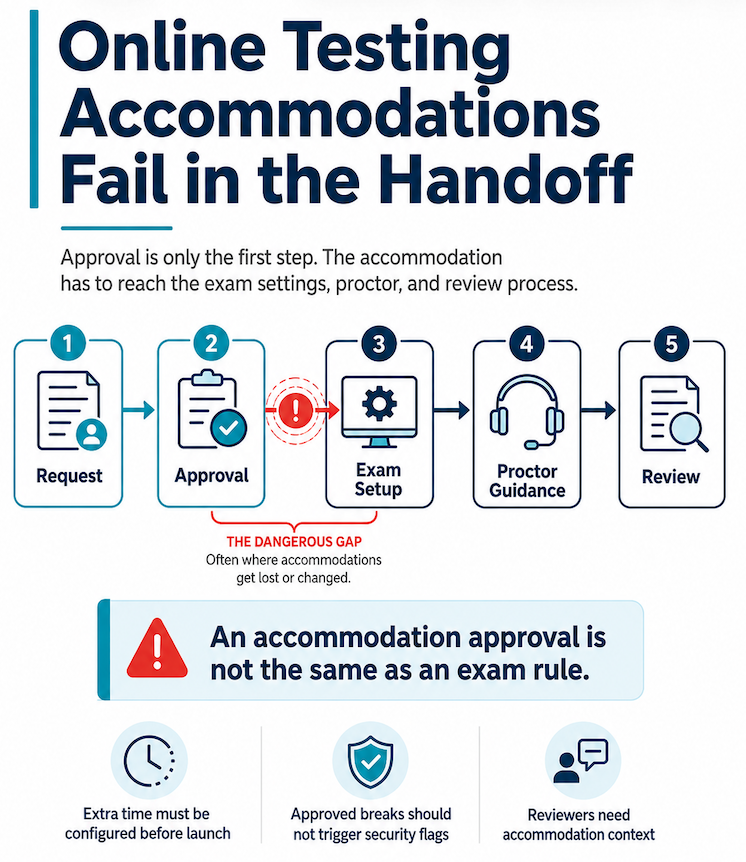
That is where the work gets complicated. A candidate may receive an approved break, extra time, or assistive technology. But if that approval does not make it into the exam setup, proctor instructions, and post-exam review process, the accommodation can create confusion on exam day.
Key insight: Online testing accommodations only work when approval, exam settings, proctor instructions, and review records all say the same thing.
Why Online Testing Accommodations Matter
Testing accommodations exist because a standardized exam experience does not always create equal access. Some candidates need changes to timing, equipment, format, breaks, or communication to demonstrate their knowledge under fair conditions.
For a certification body, that creates two responsibilities at the same time. You need to give candidates a fair opportunity to test. You also need to protect the validity, security, and comparability of the credential.
Accommodations protect access
A candidate with an approved disability accommodation may need extra time, screen reader access, scheduled medical breaks, reduced proctor interaction, or permission to use specific equipment. The purpose is not to make the exam easier. The purpose is to remove barriers that prevent the candidate from accessing the exam fairly.
Controls protect the credential
Certification exams often carry real consequences. They may affect employment, licensure pathways, regulatory compliance, member standing, public safety, or professional advancement. If your accommodation process creates inconsistent exam conditions or unclear security decisions, the program absorbs the risk.
That is why online testing accommodations need more than a policy statement. They need an operational workflow that survives handoffs between staff, candidates, exam settings, proctors, and reviewers.
If your program uses remote proctoring, see how Gauge supports online proctoring for secure certification exams.
Common Online Testing Accommodations
Online exam accommodations vary by candidate, program policy, applicable law, and the nature of the exam. A high-stakes certification exam may support many of the same accommodations as a test-center exam, but the delivery details often look different online.
| Accommodation type | What it may involve | Operational risk if missed |
|---|---|---|
| Extended time | Additional exam time, often configured before launch. | Candidate loses approved time |
| Scheduled breaks | Approved pauses for medical, disability, or nursing-related needs. | Break triggers security flag |
| Assistive technology | Screen readers, magnification tools, adaptive input devices, or approved software. | Tool appears unauthorized |
| Modified proctor interaction | Reduced interruptions, written instructions, or specific communication rules. | Proctor disrupts the exam |
| Approved personal items | Medication, food, water, medical devices, or other approved items. | Item treated as prohibited |
The table shows why accommodations cannot live only in an approval email. The approval has to turn into a specific exam rule, and that rule has to be visible to the right people at the right time.
For U.S. programs, the ADA provides broad guidance on disability rights and access obligations. See the ADA.gov resource center for official information.
Where Online Testing Accommodations Break Down
Most accommodation failures do not come from bad intent. They come from weak handoffs. A candidate submits documentation. Staff approve the request. Someone adds a note. The exam gets scheduled. The proctor sees a different set of rules. The review team later sees a flag with incomplete context.
Approval does not reach the exam settings
Extra time is one of the simplest examples. If staff approve 50 percent additional time but the online exam still launches with the standard time limit, the candidate experiences a failure of process. The platform has to reflect the approved rule before the exam begins.
Proctors do not receive the right instructions
An approved accommodation may allow a candidate to take scheduled breaks, use medical equipment, access a screen reader, or communicate in a specific way. If the proctor does not know that, the candidate may face interruptions, warnings, or unnecessary stress during the exam.
Approved behavior looks suspicious later
Remote proctoring systems can flag behavior that looks unusual. That may include leaving the camera view, using an assistive tool, pausing the exam, speaking aloud, or interacting with another approved support person. Without accommodation context, a reviewer may treat an approved condition as a security concern.
Real-World Example: Healthcare Certification
A nursing certification candidate receives approval for scheduled medical breaks during an online proctored renewal exam. If the proctoring record does not show that approval, each break may appear as a potential testing violation instead of an authorized accommodation.
For a related look at online exam risk, see Gauge’s article on how candidates cheat on online exams and how to stop it.
How to Manage Online Testing Accommodations Without Losing Control
A strong accommodations workflow does not force staff to choose between access and security. It creates a controlled path from request to approval to exam delivery to review.
Separate the policy decision from the exam setup.
Your policy defines who qualifies, what documentation is required, and how decisions are made. Your exam setup turns that decision into time limits, allowed tools, break rules, proctor notes, and review instructions.
Document the approved accommodation clearly.
Staff should know what was approved, when it applies, which exam attempt it affects, and whether it applies to future attempts. Avoid vague notes that require staff interpretation on exam day.
Configure the exam before launch.
If a candidate has extra time, the exam timer should reflect that. If breaks are approved, the delivery workflow should account for them. If assistive technology is allowed, the testing environment should not block it unexpectedly.
Give proctors only the information they need.
Proctors need actionable instructions, not sensitive medical details. They should know what behavior is allowed, what should be flagged, and when to escalate.
Review flags with accommodation context.
A post-exam reviewer should be able to distinguish approved behavior from a real security issue. That requires the accommodation record to follow the candidate into review.
Audit the workflow regularly.
Look for repeated issues, such as extra time not applying, proctors misunderstanding break rules, or reviewers flagging approved behaviors. Those patterns show where the process needs tightening.
If accommodations need to connect to exam rules, item banks, timing, and delivery controls, see how Gauge supports advanced online testing for certification programs.
Online Testing Accommodations and Exam Security
Certification teams sometimes worry that accommodations will weaken exam control. The better way to frame it is this: accommodations weaken control only when they are handled informally.
A well-managed accommodation does not remove security. It changes the rules for a specific candidate in a documented and approved way. The exam remains controlled because the platform, staff, proctor, and reviewer all understand the same conditions.
| Question | Weak process | Controlled process |
|---|---|---|
| Who approved the accommodation? | Buried in email | Recorded in the workflow |
| What changed in the exam? | Manually interpreted | Configured before launch |
| What does the proctor know? | Generic instructions | Candidate-specific rules |
| How are flags reviewed? | Without context | Against approved conditions |
The goal is not to make every candidate’s exam identical. The goal is to make every exam fair, defensible, and properly controlled based on the conditions approved for that candidate.
For government and public-sector programs, Section 508 is also relevant when digital systems must support accessibility. See the official Section508.gov resource for federal accessibility guidance.
What to Look for in an Online Testing Platform
When you evaluate online testing accommodations, do not stop at whether the platform can add extra time. That is only one piece of the workflow. The better question is whether your process can carry accommodation decisions cleanly from approval through exam review.
Candidate-specific exam settings
Your team should be able to adjust timing, access rules, delivery settings, and approved conditions for specific candidates without rebuilding the entire exam. That matters when candidates take the same certification exam under different approved conditions.
Clear proctor instructions
Proctors need instructions that focus on exam delivery. For example, a proctor may need to know that the candidate has two approved breaks or may use a specific assistive tool. They do not need unnecessary medical detail.
Defensible records
Your team should be able to reconstruct what was approved, what settings were used, what happened during the session, and how any flags were resolved. That is especially important when a candidate appeals, a sponsor asks for review, or leadership wants proof that the process is under control.
For a broader look at the exam delivery process, see Gauge’s article on test administration for certification programs.
Frequently Asked Questions About Online Testing Accommodations
What are online testing accommodations?
Online testing accommodations are approved changes that help a candidate access an online exam fairly. They may include extra time, breaks, assistive technology, adjusted proctoring instructions, accessible formats, or approved personal items.
Can online proctored exams support accommodations?
Yes, online proctored exams can support accommodations when the approval is translated into exam settings and proctor instructions. The key is making sure approved behaviors do not get mistaken for testing violations.
How should we handle extra time in an online exam?
Extra time should be configured before the candidate starts the exam. Staff should not rely on manual correction after launch because that creates stress for the candidate and risk for the program.
Do accommodations weaken exam security?
Accommodations do not weaken exam security when they are approved, documented, configured, and reviewed correctly. They create risk when they are handled informally or when proctors and reviewers do not know what conditions were approved.
What is the biggest mistake certification programs make with online testing accommodations?
The biggest mistake is treating the accommodation as a note instead of an executable exam rule. A note may explain what was approved, but the exam platform, proctor, and reviewer need that approval reflected in the actual delivery workflow.
The Real Goal of Online Testing Accommodations
The real goal of online testing accommodations is not to create exceptions around the exam. It is to create fair access inside a controlled exam process.
That requires more than good intentions. It requires a workflow that connects policy, approval, exam configuration, proctor guidance, candidate communication, and post-exam review.
If your certification program is moving more exams online, Gauge helps bring that kind of operational control into the testing process. It gives teams a clearer way to manage exam delivery, proctoring, candidate-specific rules, and the records behind high-stakes testing. When accommodations are part of the workflow instead of side notes, your team can support candidates without losing control of the exam.
See It In Action
Ready to see how Gauge handles online testing accommodations for organizations like yours?
No commitment, no pressure. Just a clear look at whether Gauge is the right fit.