
Test Blueprint: What It Is, How to Create One, and Why It Matters
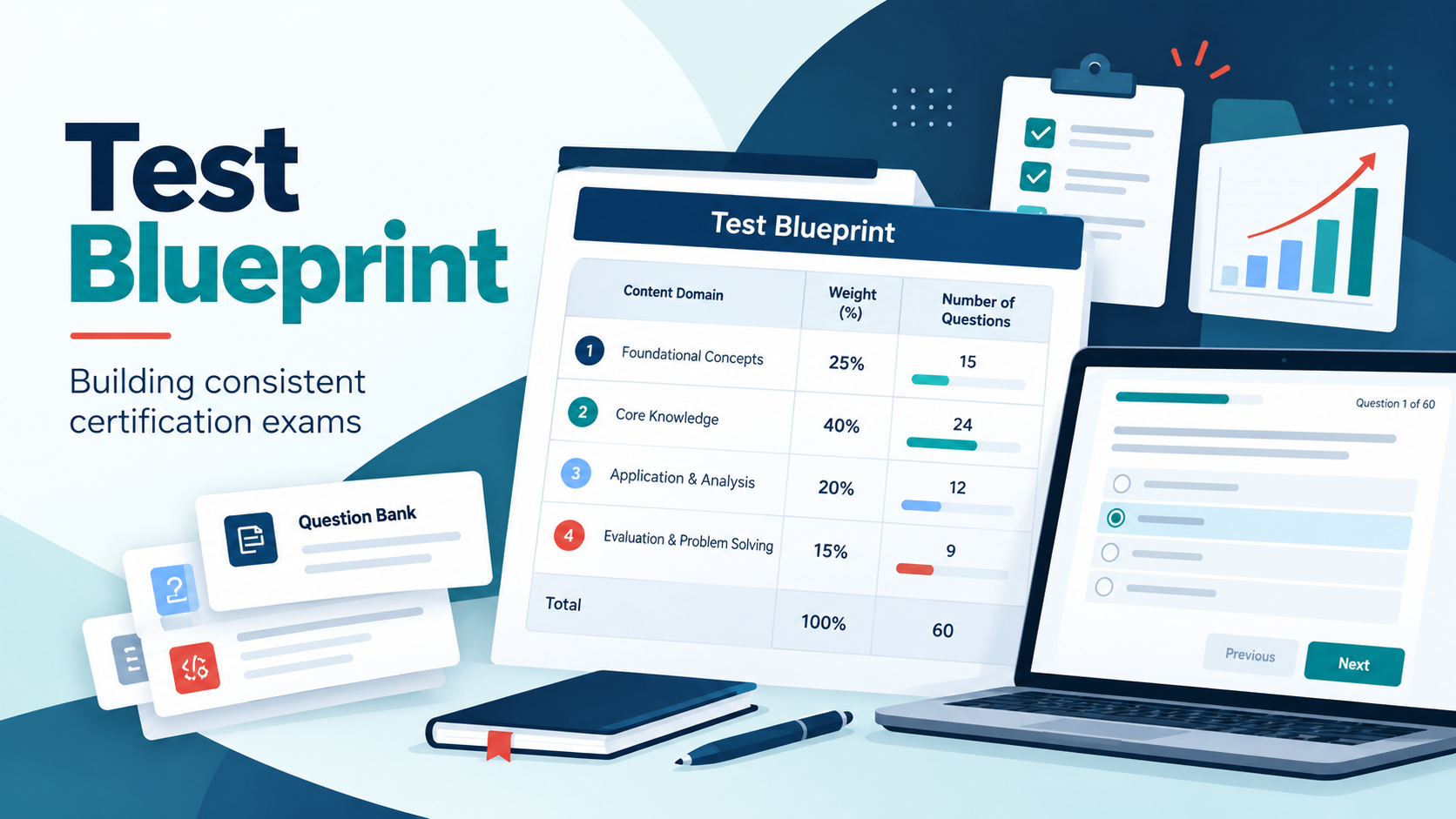
A test blueprint is a structured plan that defines what an examination will measure, how much emphasis each topic receives, and how questions should be distributed across the assessment. Also called an exam blueprint or table of specifications, it provides the foundation for building consistent, defensible examinations.
For certification organizations, professional associations, and training providers, a test blueprint is particularly important. It helps ensure that exams assess the intended knowledge and skills rather than simply drawing questions from whatever happens to be available in a question bank.
This guide explains what belongs in a test blueprint, provides a practical example, and outlines how to translate your blueprint into an online examination.
What Is a Test Blueprint?
A test blueprint is a document that specifies the content areas, competencies, and relative weighting of an examination. It establishes a consistent structure that exam developers can follow when selecting or creating questions.
For example, a professional certification exam might measure five competency areas. Rather than distributing questions evenly across all five, the organization may determine that certain competencies are more critical to professional practice and should receive greater emphasis.
The blueprint captures those decisions before the exam is assembled.
The American Board of Internal Medicine describes its exam blueprint as a table of specifications identifying the content and target percentage of questions for each primary category. This approach helps maintain content representation across examination administrations.
What Should a Test Blueprint Include?
The exact structure varies depending on the purpose of the examination. However, most certification exam blueprints contain several essential elements.
1. Content Domains and Competencies
Content domains are the major knowledge or skill categories covered by an assessment. Each domain may contain subdomains, learning objectives, or specific tasks that candidates are expected to perform.
For example, a certification examination might include regulatory knowledge, operational procedures, safety requirements, and applied problem-solving.
2. Domain Weighting
Each domain receives a percentage of the total examination. These percentages should reflect the importance of the competencies being evaluated, rather than the number of questions that happen to be available.
For professional credentialing programs, domain weights are commonly informed by a job or practice analysis and reviewed by subject matter experts.
3. Number of Questions
The blueprint translates percentages into specific question counts for the examination. A 100-question exam with a 25% allocation to safety procedures would require 25 questions in that domain.
For exams with totals that do not divide neatly, administrators should document the rounding rules used to allocate questions.
4. Cognitive Complexity
A well-designed assessment may evaluate different levels of understanding, including recalling information, applying knowledge, and analyzing situations.
Depending on the examination’s purpose, the blueprint can specify how many questions should assess each cognitive level.
5. Question Types and Examination Specifications
The larger test specifications document may also define question formats, examination duration, scoring rules, security requirements, and other delivery conditions.
These specifications help ensure that the examination measures the intended competencies under consistent conditions.
Test Blueprint Example: A 100-Question Certification Exam
Consider a fictional professional certification program delivering a 100-question examination. Its subject matter experts have identified five competency domains and assigned each a relative weight.
| Content Domain | Weight | Questions |
|---|---|---|
| Regulatory Knowledge | 20% | 20 |
| Operational Procedures | 30% | 30 |
| Safety and Compliance | 25% | 25 |
| Applied Problem-Solving | 15% | 15 |
| Professional Responsibilities | 10% | 10 |
| Total | 100% | 100 |
In this example, every assembled exam must contain the specified number of questions from each domain. The questions themselves may vary between examinations, provided the required content distribution is maintained.
Administrators may also establish subdomain requirements or difficulty targets within each category. This creates a more detailed blueprint that can guide both question development and examination assembly.
Note: These percentages are illustrative. Actual certification exam weights should be supported by the program’s competency framework and relevant validation activities.
How to Create a Test Blueprint: Step by Step
Developing a useful test blueprint requires more than dividing questions into categories. The objective is to establish a documented connection between the competencies candidates need and the content being assessed.
Step 1: Define the Examination’s Purpose
Begin by documenting what the examination is intended to measure and what decisions will be made using its results.
An employee training assessment might evaluate mastery of recent course material. A professional certification examination may need to establish whether candidates possess knowledge and skills necessary for competent practice.
These assessments can require different levels of documentation and validation.
Step 2: Identify the Competencies Being Tested
List the knowledge, skills, responsibilities, or performance objectives relevant to the examination.
For professional certifications, a formal job or practice analysis may provide the evidence needed to define these competencies. Subject matter experts can then help organize them into clearly defined domains and subdomains.
For a practical example of this process, the Association for Talent Development’s certification development process explains how competency research informs detailed examination content outlines.
Step 3: Assign Weights to Each Domain
Determine the proportion of the examination that should address each domain.
Weighting decisions may consider how frequently a competency is used, its importance to professional performance, and the consequences of performing it incorrectly.
Document the rationale behind these decisions. This becomes especially important when the program reviews or revises its examination in the future.
Step 4: Define Question Counts and Cognitive Levels
Translate the domain weights into question counts and, where appropriate, establish additional specifications for cognitive complexity or question type.
For example, a safety domain may include both knowledge questions and scenario-based questions that evaluate whether a candidate can apply appropriate procedures.
A blueprint should account for the examination’s scored questions and separately document how any unscored pilot questions are handled.
Step 5: Map Questions to the Blueprint
Once the blueprint is established, each question in the examination bank should be associated with the appropriate domain and, when applicable, subdomain, objective, and difficulty classification.
This mapping makes it possible to identify coverage gaps before an exam is administered.
For example, a bank containing 500 questions may appear sufficiently large until administrators discover that most questions are concentrated in only two of the five required domains.
Step 6: Validate and Maintain the Blueprint
Review the blueprint with qualified subject matter experts and, for higher-stakes credentialing programs, appropriate psychometric expertise.
As professional responsibilities, regulations, and industry practices change, examination content and domain weights may need to be updated.
Maintain version histories and approval records so administrators can establish which blueprint governed each examination administration.
How Test Blueprints Support Randomized Exams
Many online testing programs use randomized questions to reduce repeated exposure to identical examination forms. However, unrestricted randomization can introduce inconsistencies.
Imagine a question bank containing 1,000 questions. If every candidate simply receives 100 randomly selected questions, some examinations might emphasize safety while others emphasize regulatory knowledge or operational procedures.
Even though the questions come from the same bank, the examinations may not reflect the same intended content distribution.
Blueprint-based randomization addresses this problem by selecting questions within predefined domain requirements.
Using our earlier example, the examination assembly process would draw:
- 20 questions from Regulatory Knowledge
- 30 questions from Operational Procedures
- 25 questions from Safety and Compliance
- 15 questions from Applied Problem-Solving
- 10 questions from Professional Responsibilities
The specific questions can change between candidates while the overall allocation remains consistent.
This approach can help maintain content coverage across exam forms. However, equivalent domain distributions do not automatically establish equivalent difficulty or statistical comparability. Those considerations may require additional item analysis, form review, or psychometric procedures.
How to Build Dynamic, Randomized Exams With Gauge
Common Test Blueprint Mistakes to Avoid
Building the Blueprint Around Existing Questions
An examination’s structure should reflect the competencies being evaluated, not simply the distribution of questions already available.
If a critical domain is underrepresented, the appropriate response may be to develop additional questions rather than reduce the domain’s weight.
Confusing Question Quantity With Examination Quality
Large question banks are useful, but quantity alone does not establish content validity, appropriate difficulty, or effective measurement.
Questions should be evaluated for relevance, clarity, accuracy, and alignment with the objectives they are intended to assess.
Ignoring Cognitive Complexity
An examination intended to establish practical competence may fall short if every question evaluates only factual recall.
Blueprinting can help ensure that the intended range of cognitive skills is represented.
Allowing the Blueprint to Become Outdated
An unchanged examination blueprint can eventually become disconnected from current professional practice.
Certification organizations should establish a documented review process, including triggers for reconsidering competencies when regulations, technologies, or professional expectations change.
Using Online Testing Software to Implement a Test Blueprint
Creating the blueprint is an assessment-design responsibility. Implementing it consistently is an operational responsibility.
For programs delivering hundreds or thousands of examinations each year, testing software can help translate the approved blueprint into repeatable examination configurations.
Important capabilities to evaluate include:
- Question categorization: Organizing questions by content domain, subject, or objective.
- Question banks: Maintaining sufficient approved questions within each required category.
- Controlled randomization: Selecting questions according to predefined domain allocations.
- Difficulty controls: Supporting difficulty-based selection where the exam design requires it.
- Reporting: Analyzing candidate performance by examination category.
- Administration records: Preserving appropriate information about delivered examinations and their configurations.
These capabilities can reduce manual examination assembly work, but they do not replace the subject matter expertise and validation needed to develop a defensible blueprint.
How Gauge Online Supports Blueprint-Based Testing
Gauge Online provides advanced online testing functionality that can support organizations implementing content-based examination structures.
Administrators can organize questions using categories, domains, and subjects; build examinations from question banks; and configure randomized question selection.
Gauge also supports examination configurations involving question difficulty, sections, scoring rules, and other delivery settings.
For a certification program, these capabilities provide building blocks for translating a documented examination blueprint into an online testing workflow.
For example, administrators designing a 100-question certification exam can organize the underlying question banks around the five approved competency domains and configure the examination to use the intended content structure.
The exact implementation should be tested against the program’s requirements, particularly when multiple constraints such as domain weighting, difficulty distribution, and random selection must be satisfied simultaneously.
Frequently Asked Questions About Test Blueprints
What is the difference between a test blueprint and an exam content outline?
A test blueprint describes the examination’s content and weighting requirements. An exam content outline may be a public-facing representation of that blueprint, showing candidates which domains will be assessed and their relative importance. Terminology varies between certification programs.
Is a test blueprint required for certification exams?
Test blueprints are an established practice in professional certification exam development. Specific documentation requirements depend on the credentialing program, applicable standards, and accreditation goals. Organizations pursuing formal accreditation should review the relevant standards and assessment-development requirements.
How many domains should a test blueprint contain?
There is no universal number. Domains should reflect meaningful distinctions between the competencies being assessed. A blueprint with too few domains may obscure important content differences, while one with too many may make examination assembly unnecessarily complicated.
Can a test blueprint be used with randomized examinations?
Yes. Blueprint-based randomization allows questions to vary while preserving specified content-domain allocations. Additional controls may be necessary to manage difficulty, item exposure, and comparability between examination forms.
How often should a test blueprint be updated?
Review frequency should reflect changes in professional practice, regulations, assessment objectives, and the credentialing program’s governance requirements. Material changes in the profession may justify an earlier review than the program’s normal review cycle.
Building a More Consistent Certification Examination
A well-developed test blueprint establishes the connection between the competencies an organization intends to measure and the questions candidates actually encounter.
For certification programs, that connection matters throughout the examination lifecycle, from initial question development and form assembly to ongoing review and reporting.
The most effective approach combines a documented blueprint, appropriately reviewed questions, suitable examination delivery technology, and a defined process for maintaining the assessment over time.
Gauge Online Advanced Testing
Put Your Exam Blueprint Into Practice
Explore how Gauge supports question banks, content categorization, randomized examinations, and advanced test configuration for certification programs.
Book a free 30-minute demo to discuss your examination requirements and see whether Gauge is the right fit.