
Certification Platform RFP Checklist: Requirements, Scoring, and Demo Questions
What a Certification Platform RFP Should Accomplish
A certification platform RFP should do more than produce a spreadsheet of feature responses. It should help your organization determine whether a platform can support the actual operating model behind your certification program, from registration and eligibility through testing, credential issuance, reporting, renewal, and exceptions.
For associations, that may include member portals, certification pathways, public credential directories, continuing education, renewals, and recertification. For corporate training teams, it may include employee assignments, compliance exams, recurring certification requirements, manager reporting, integrations with existing learning or HR systems, and evidence that employees remain qualified.
The strongest RFPs therefore evaluate more than whether a vendor answers “yes” to a requirement. They establish how the requirement is delivered, what other systems are involved, what evidence the vendor can provide, and what your team will be responsible for during implementation.
A useful RFP principle: Do not ask only whether a platform supports a capability. Ask vendors to identify whether it is native, configurable, delivered through an integration, requires custom development, or is not currently available.
Start With Your Certification Operating Model
Before writing individual requirements, document how your certification program is supposed to work. Otherwise, the RFP can easily become a collection of disconnected features without establishing whether those features can support the same candidate journey.
At minimum, define:
- Who becomes eligible for certification and how eligibility is determined.
- Whether training, prerequisites, applications, or approvals occur before testing.
- How examinations are delivered and secured.
- What happens after a candidate passes or fails.
- How certificates, badges, or other credentials are issued.
- Whether credentials expire and what is required for renewal or recertification.
- Which systems currently own member, employee, payment, training, or certification data.
- What administrators need to report to leadership, auditors, managers, members, or external stakeholders.
- Which exceptions require manual administrator intervention.
This gives every vendor the same future-state workflow to respond to. It also makes the demonstration more valuable because you can ask each provider to show your process instead of accepting a generic product tour.
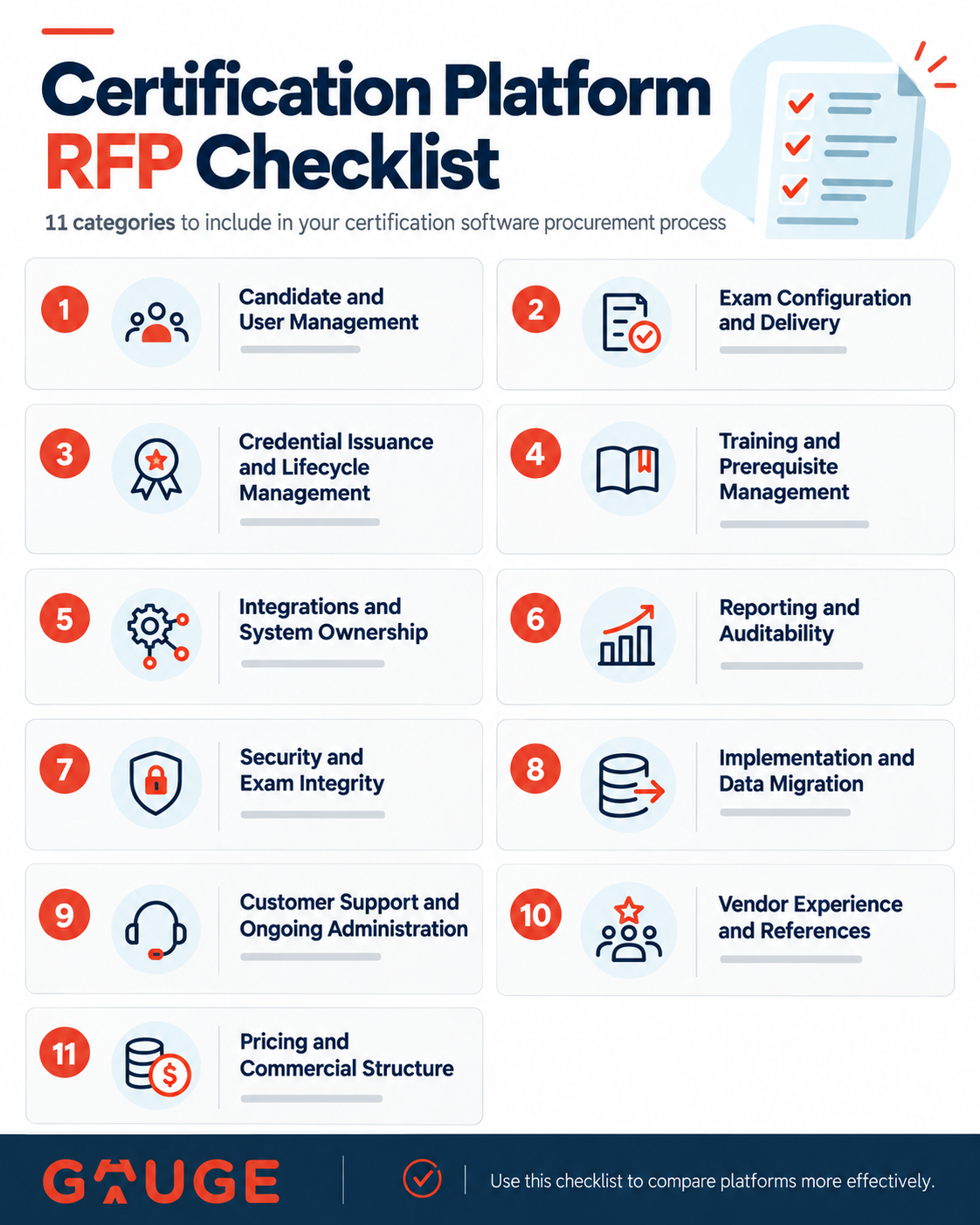
Certification Platform RFP Checklist
1. Candidate and User Management
Ask vendors to explain how candidates enter the platform and how their records remain connected throughout the certification lifecycle.
- How are candidates registered individually, in bulk, or through another system?
- Can users be organized by employer, chapter, department, membership type, certification program, or another relevant group?
- Can eligibility rules or prerequisites control access to an assessment?
- How are duplicate records identified and resolved?
- Can administrators see a complete history for an individual user?
2. Exam Configuration and Delivery
Certification exams often require more control than a standard course quiz. Your RFP should describe the assessment rules you actually use rather than simply requesting “online testing.”
- Question banks and question categorization
- Randomized or dynamically generated examinations
- Exam sections, time limits, passing thresholds, and scoring rules
- Attempt limits, waiting periods, and retake policies
- Accommodations and alternate exam configurations
- Practical or performance-based assessment workflows, if applicable
- Virtual or in-person proctoring requirements
- Administrative review of exam results and testing activity
When assessment is central to your program, evaluate the testing system as its own operational requirement. Gauge’s online testing platform, for example, is designed to support configurable exam delivery alongside the broader certification workflow.
3. Credential Issuance and Lifecycle Management
Passing an exam is often only one event in the certification lifecycle. Require vendors to show what happens after the result is recorded.
- Automatic or administrator-approved credential issuance
- Certificates and digital badges
- Credential expiration dates
- Renewal and recertification requirements
- Reminder communications
- Credential status reporting
- Revocation, suspension, or administrator corrections when required
- Historical records showing how credential status changed over time
If certification management is a major reason for changing systems, require vendors to demonstrate the entire lifecycle rather than showing only a certificate template. Gauge’s certification and badging capabilities connect credential issuance and lifecycle management with testing activity.
4. Training and Prerequisite Management
Associations and corporate training teams should identify where training belongs in the workflow. Determine whether the certification platform needs to deliver learning content directly or simply receive completion information from another system.
The important RFP question is not “Do you have an LMS?” It is: How does completion of required learning affect eligibility, testing, certification status, and reporting?
5. Integrations and System Ownership
Few organizations are replacing every system at once. Your RFP should identify which application owns each important type of data and what needs to move between systems.
Ask about:
- Single Sign-On
- APIs and webhooks
- Association or member-management systems
- Learning management systems
- HR or employee systems
- Ecommerce or payment workflows
- Public credential or member directories
- Reporting and business-intelligence tools
Do not leave “integration available” as the final answer. Ask who builds it, what data moves in each direction, how often it moves, which system is authoritative, how errors are handled, and whether additional fees apply.
6. Reporting and Auditability
Reporting requirements should reflect the questions your team actually needs to answer.
- Who is currently certified?
- Whose certification will expire soon?
- Who attempted or passed a specific exam?
- How is an individual candidate progressing through the program?
- What assessment data is available for item or exam analysis?
- Can reports be segmented by group, employer, department, program, or another organizational structure?
- Can data be exported for additional analysis?
- Can administrators reconstruct what happened when a result, eligibility status, or credential changes?
7. Security and Exam Integrity
Security requirements should reflect the consequences of an invalid result. Ask vendors to explain the controls surrounding administrator access, candidate identity, exam delivery, question exposure, proctoring, data protection, and incident response that apply to your use case.
If third-party services are involved, require vendors to identify which company is responsible for the candidate experience, technical support, billing, configuration, and incident resolution.
8. Implementation and Data Migration
Implementation deserves its own scored section. Many platform problems appear after vendor selection because the RFP evaluated software capabilities without evaluating the work required to make them operational.
Require a proposed implementation plan covering:
- Discovery and requirements validation
- Data preparation and migration
- Exam and question-bank migration
- Certification workflow configuration
- Integrations
- Administrator training
- Internal testing
- User acceptance testing
- Go-live criteria
- Post-launch support
Also require the vendor to identify what your team must provide and when. A project plan that lists only vendor responsibilities leaves half of the implementation risk undocumented.
9. Customer Support and Ongoing Administration
Support should be evaluated as an operating capability, not a checkbox.
- Who supports administrators?
- Who supports candidates?
- What support channels are available?
- How are urgent exam-day issues handled?
- Will your organization have a consistent point of contact?
- What configuration changes can the vendor assist with?
- What work is included in the subscription versus professional services?
This category is particularly important when your certification team is small. Software that technically supports a workflow may still create substantial internal work if the vendor’s service model does not match your staffing model.
10. Vendor Experience and References
Ask for references that resemble your program in operational complexity, not simply organizations with recognizable names. Relevant factors may include candidate volume, accreditation requirements, integrations, renewal workflows, high-stakes testing, practical assessments, or the size of the administrative team.
Useful reference questions include:
- What did implementation actually require from your staff?
- How responsive is the vendor when something unusual happens?
- Has the platform adapted as your program changed?
- What administrative work was reduced?
- What do you wish you had understood before implementation?
- Would you choose the platform again?
11. Pricing and Commercial Structure
Require enough pricing detail to compare total operating cost, not just subscription price. Include platform licensing, implementation, data migration, integrations, proctoring, support, professional services, transaction or exam charges, credential issuance, and expected renewal increases where applicable.
Ask vendors to distinguish required costs from optional services and identify assumptions that could materially change the proposal.
Require Vendors to Classify Every RFP Response
One of the easiest ways to improve a certification platform RFP is to stop accepting unrestricted yes-or-no responses. Require each vendor to classify how the requirement is satisfied.
| Response | Meaning |
|---|---|
| Native | Included in the existing product without additional development. |
| Configurable | Supported by the existing platform but requires configuration for your program. |
| Integration | Requires another product or system to complete the workflow. |
| Custom Development | Requires software development that is not part of the current standard product. |
| Not Available | The requirement cannot currently be supported as requested. |
For integrations, custom development, and third-party dependencies, require an explanation of cost, implementation responsibility, and expected timeline.
Turn the Certification Platform Demo Into an Acceptance Test
A polished product tour shows what a platform can present. A useful RFP demonstration shows whether it can operate your program.
Give shortlisted vendors the same scenarios in advance and ask them to demonstrate each one.
Register a candidate, establish eligibility, deliver any required learning or prerequisite, administer the exam, record the result, issue the credential, and show the resulting administrator record.
Demonstrate how expiration is calculated, how the candidate is notified, what must be completed, and how the credential history changes after renewal.
Show a failed exam, expired credential, missing prerequisite, duplicate user, approved exception, or incorrect result and demonstrate how an administrator resolves it.
Demonstrate how user, exam, certification, or completion data moves between systems and what happens when that transfer fails.
Find a candidate, reconstruct their history, identify their current certification status, and produce the report your team would use to make a real decision.
Useful demo request: “Show us how one participant moves through our actual certification requirements, then show us how an administrator identifies and resolves an exception.”
Build a Scoring Model Before Proposals Arrive
Define evaluation criteria before seeing vendor responses. Otherwise, scoring can drift toward whichever demonstration, salesperson, or interface creates the strongest impression.
A starting framework might look like this:
| Evaluation Area | Example Weight |
|---|---|
| Certification workflow and candidate management | 20% |
| Assessment and exam delivery | 15% |
| Credential lifecycle and renewals | 15% |
| Integrations and data management | 15% |
| Implementation and migration | 10% |
| Reporting, security, and auditability | 10% |
| Support and vendor experience | 10% |
| Pricing and commercial terms | 5% |
The exact weighting should reflect your program. A corporate compliance program may assign more weight to integrations and manager reporting. A professional association operating a high-stakes credential may place more weight on exam delivery, certification governance, renewals, and auditability.
The Certification Platform RFP Questions Buyers Often Miss
Feature requirements matter, but some of the most important procurement questions sit between the features:
- Which system will be the source of truth? Define ownership for identity, eligibility, exam results, certification status, and renewal data.
- What happens when the normal workflow fails? Require vendors to demonstrate exceptions, not only successful scenarios.
- Which capabilities depend on another provider? Identify responsibility for support, contracts, configuration, and data exchange.
- What requires configuration versus software development? The distinction can materially affect implementation cost and timeline.
- How will historical records be migrated and validated? Moving data is different from proving that the resulting certification record is correct.
- What will our team need to do after launch? Administrative effort should be part of the platform evaluation.
- How do we get our data back? Ask about exports, record retention, and transition support before you need them.
What Gauge Has Learned From Supporting Certification Programs
The most useful platform evaluations tend to focus on the connections between activities rather than evaluating each feature in isolation. Exam delivery affects credential issuance. Eligibility affects testing access. Integrations affect administrative workload. Renewal logic affects communications and reporting. Support becomes especially important when an exception crosses several of those workflows.
Gauge customers provide practical examples of that operating model. One professional certification organization administers approximately 5,000 exams annually through Gauge while using the platform for exam delivery, certification records, credential management, renewals, practical assessments, reporting, and integration with external registration systems.
Another certification organization uses Gauge for thousands of annual exams together with renewals, training materials, candidate administration, and Single Sign-On to its member-facing systems. Its team describes the value simply: “Gauge provides the stability and flexibility we need to support our certification program at scale.”
An association using Gauge for certification examinations and credential issuance also connects the platform with its public member directory through APIs and webhooks. When certification activity occurs, relevant information can move to the organization’s external system rather than requiring staff to reconcile the systems manually.
Those examples are why Gauge approaches certification-platform evaluations as workflow decisions rather than software feature contests. The goal is not to accumulate the longest feature list. It is to determine whether the platform, implementation model, integrations, and support structure can operate the certification program you actually need to run.
Frequently Asked Questions
What should be included in a certification platform RFP?
Include your operating model, candidate management, assessment requirements, credential issuance and renewals, training or prerequisites, integrations, reporting, security, implementation, migration, support, vendor references, pricing, and evaluation criteria. Require vendors to explain how each important requirement is delivered rather than accepting yes-or-no responses.
Should a certification platform replace our LMS?
Not necessarily. First decide which system should own learning, eligibility, examination, and certification data. Some organizations benefit from consolidating more of the workflow, while others should integrate a certification platform with an existing LMS or another system that remains useful.
How should we compare certification platform vendors?
Give vendors the same requirements, response classifications, demo scenarios, pricing template, and scoring criteria. Compare how each platform supports your real workflow, including implementation and exception handling, rather than comparing feature counts alone.
Should price be heavily weighted in a certification platform RFP?
Price should be evaluated in context. Compare total operating cost, including licensing, implementation, integrations, proctoring, professional services, support, internal administration, and any separate systems that remain necessary. The cheapest subscription can still produce a more expensive operating model.
Use the RFP to Test Gauge the Same Way
If you are developing a certification platform RFP, Gauge can walk through these same requirements with your team. Bring your current workflow, difficult requirements, integration questions, renewal rules, and administrative pain points. The goal of the conversation should be to determine where Gauge fits, what would need to be configured, and where another system may still need to remain part of your architecture.
You can then use the same criteria to compare Gauge with the other platforms on your shortlist.
Bring us your workflow and requirements. We will show you how Gauge would handle them so you can make a more informed comparison.