
NCCA Accreditation: What Certification Programs Need and How It Compares to ISO/IEC 17024
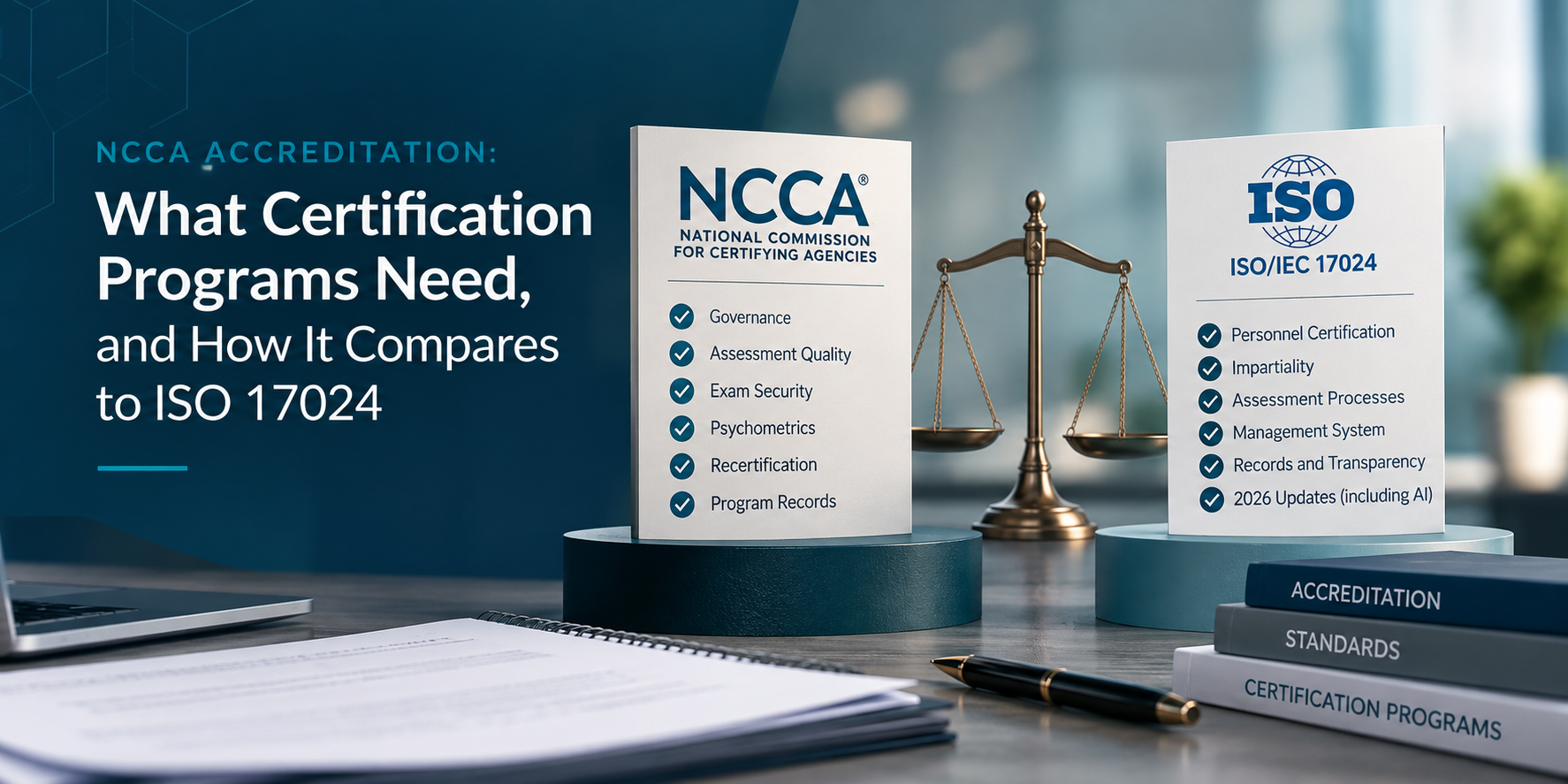
What NCCA Accreditation Actually Means
NCCA accreditation is an independent review of a professional certification program against recognized standards for how that program is governed, developed, administered, assessed, and maintained. It is intended to demonstrate that certification decisions are supported by a consistent and defensible process, not simply that an organization delivers an exam.
For certification leaders, that distinction matters. Accreditation reaches well beyond exam day. Your organization needs to demonstrate how eligibility is determined, how the assessment reflects the profession, how certification decisions remain impartial, how candidate information is protected, how complaints and appeals are handled, and how certified individuals maintain their credentials over time.
The Institute for Credentialing Excellence currently uses the 2021 NCCA Standards as the foundation for NCCA accreditation. Those standards apply to professional certification programs across industries and focus on the rigor and integrity of the complete certification process.
Key insight: Accreditation is not a feature you buy from a testing vendor. It is evidence that your organization has designed, documented, implemented, and maintained a defensible certification program.
What Certification Programs Need for NCCA Accreditation
A strong NCCA application is built long before the application portal opens. The program needs operating history, documented policies, assessment evidence, governance records, and proof that the organization follows its own procedures in practice.
Eligibility comes after the program has operated
A new certification program can become eligible to apply after it has administered its assessment for one year or assessed at least 500 candidates, whichever occurs first. The reason is practical: reviewers need evidence that the program has actually carried out the activities described in its policies, including assessment administration and scoring.
Prepare the program in six areas
Document the certification’s purpose, scope, eligibility requirements, decision authority, committee responsibilities, and methods for protecting certification decisions from inappropriate influence.
Certification examinations need a defensible connection to the profession or role being certified. That usually includes a job or practice analysis, examination specifications, subject-matter-expert involvement, scoring methodology, and appropriate psychometric analysis.
Your policies should address conflicts of interest, impartial certification decisions, candidate eligibility, accommodations, complaints, appeals, and the relationship between certification and any education or training your organization provides.
Programs need documented controls for examination materials, candidate records, administrative access, delivery conditions, confidentiality, incidents, and other risks that could affect the integrity of a certification decision.
Accreditation does not stop when a credential is issued. Your program needs documented rules for maintaining certification, including validity periods, renewal or recertification requirements, expiration, and changes in certification status.
Do not wait until application month to reconstruct your program. Preserve meeting records, policies, SME participation, examination reports, security procedures, candidate communications, certification decisions, psychometric documentation, and examples showing that your written procedures are actually followed.
NCCA currently accepts applications three times each year, with deadlines in January, April, and August. I.C.E. states that the accreditation process generally takes about four to five months from submission through the accreditation decision.
NCCA vs. ISO/IEC 17024: What Is the Difference?
NCCA accreditation and ISO/IEC 17024 address many of the same underlying concerns, including competence, impartiality, assessment quality, security, records, and continued certification. They are not interchangeable frameworks.
The simplest distinction is that NCCA accreditation focuses on the quality of an individual professional certification program. ISO/IEC 17024 establishes requirements for the certification body operating certification of persons and the certification schemes it manages.
| Area | NCCA Accreditation | ISO/IEC 17024 |
|---|---|---|
| Primary focus | Professional certification program quality | Bodies operating certification of persons and their certification schemes |
| Current standard | 2021 NCCA Standards | ISO/IEC 17024:2026, Edition 3 |
| Recognition context | Established national benchmark within the U.S. professional credentialing community | International conformity-assessment standard designed to support recognition across markets |
| Governance and impartiality | Certification governance, autonomy, stakeholder responsibilities, and impartial decisions | Detailed requirements for impartiality, organizational structure, responsibility, resources, and conflicts |
| Assessment | Strong emphasis on defensible assessment instruments, validity, reliability, fairness, and psychometric evidence | Requirements for assessment and examination processes within the certification scheme |
| Management system | Program policies, governance, documentation, and continued compliance | Explicit organizational and management-system requirements |
| Artificial intelligence | I.C.E. provides guidance on responsible AI use within the NCCA framework | The 2026 edition includes dedicated requirements related to AI use in certification processes |
The overlap is substantial, but overlap does not mean equivalence. Evidence that satisfies one framework should be mapped carefully before assuming it satisfies the other.
A Major 2026 Change to ISO/IEC 17024
Certification teams researching ISO/IEC 17024 should pay close attention to the edition they are reading. ISO published ISO/IEC 17024:2026 in March 2026, and the previous 2012 edition is now withdrawn.
The new edition updates terminology and introduces requirements addressing the use of artificial intelligence in certification processes. ISO specifically identifies human oversight, monitoring of AI-generated outcomes, fairness, transparency, and appropriate competence in the use of AI tools as areas addressed by the revision.
That means an older NCCA-to-ISO crosswalk developed against the 2012 standard can still be useful for understanding the historical overlap, but it should not be treated as proof of compliance with the 2026 edition without being revalidated.
The former I.C.E. dual-accreditation route has also ended
I.C.E. previously partnered with International Accreditation Service to provide a streamlined pathway for organizations seeking both NCCA and ISO/IEC 17024 accreditation. I.C.E. now states that this Dual Accreditation Program has been discontinued. Programs considering both frameworks should therefore verify the current ISO accreditation pathway directly rather than relying on older instructions describing the former joint application process.
Where NCCA and ISO/IEC 17024 Overlap
Although the structures differ, both frameworks are trying to answer a similar question: can stakeholders trust the certification decision?
That requires more than a difficult exam. Certification programs need defensible evidence surrounding the entire decision process, including governance, eligibility, assessment, security, impartiality, records, certification status, recertification, complaints, and appeals.
This is why accreditation projects often expose operational weaknesses that have little to do with the content of the examination itself. A program may have excellent questions and still struggle to demonstrate who approved an eligibility exception, which examination form a candidate received, how an incident was resolved, or why a credential remained active after renewal.
What Your Certification Technology Needs to Support
Neither NCCA nor ISO/IEC 17024 accreditation comes from selecting a particular testing platform. Your technology does, however, determine how easily your team can follow its procedures and produce evidence showing what happened.
| Program Requirement | Operational Evidence Your Systems Should Preserve |
|---|---|
| Candidate eligibility | Applications, prerequisites, approvals, exceptions, and candidate status history |
| Examination administration | Exam assignment, form or question selection, attempt history, timing, scores, and administrative changes |
| Psychometric oversight | Item-level and examination-level performance data that can be analyzed by qualified psychometric resources |
| Exam security | Administrative permissions, delivery controls, incident records, proctoring evidence where applicable, and security-related actions |
| Certification decision | Final result, approval status, certification issuance, effective date, expiration date, and changes in status |
| Recertification | Renewal requirements, continuing education or reassessment records, reminders, expiration, and renewal history |
A system should make this evidence easier to retrieve and harder to lose. It cannot replace appropriate governance, psychometric expertise, written policies, or accreditation judgment.
Should Your Program Pursue NCCA Accreditation or ISO/IEC 17024?
Start with the recognition your credential actually needs. If your stakeholders primarily operate within the U.S. professional credentialing environment and specifically recognize NCCA, that requirement should shape your path. If international recognition, multinational operations, regulatory expectations, or procurement requirements point toward ISO/IEC 17024, the international standard may become more important.
Some certification bodies may have a reason to pursue both. The decision should come from employer expectations, regulatory requirements, market geography, credential-holder needs, and the cost of maintaining each accreditation, not from the assumption that more accreditations automatically make a credential stronger.
Whichever path you choose, the operating principle is similar: build the program first, document it as you operate, preserve the evidence behind certification decisions, and treat accreditation as an ongoing quality system rather than a one-time application project.
Frequently Asked Questions About NCCA Accreditation
No. They overlap significantly, but they are separate accreditation frameworks. NCCA focuses on professional certification programs, while ISO/IEC 17024 establishes requirements for bodies that certify persons and the certification schemes they operate.
I.C.E. currently estimates approximately four to five months from application submission through the accreditation decision. Programs should allow substantially more time before submission to prepare policies, assessment evidence, governance documentation, and operational records.
Not necessarily. A new program may apply after one year of assessment administration or after assessing at least 500 candidates, whichever comes first. Your program still needs enough evidence to demonstrate that its assessment and certification processes are operating as intended.
No. Accreditation evaluates the certification program and its evidence, not a specific software product. Your technology should support your policies, protect examination and candidate information, preserve accurate records, and provide the data needed to demonstrate how certification decisions are made.
No software can guarantee accreditation or make a certification program compliant by itself. The platform can support secure testing, records, reporting, credential status, renewals, and auditability, but governance, psychometric quality, policies, oversight, and accreditation evidence remain the certification organization’s responsibility.
Gauge supports certification programs that operate under recognized accreditation frameworks, including programs that use Gauge for examination delivery, reporting, certification records, and credential lifecycle administration while qualified external specialists handle advanced psychometric analysis. If accreditation is part of your roadmap, the useful technology question is not whether a platform claims to be “NCCA compliant.” It is whether the system can support the controlled processes and evidence your certification program needs to defend.