
Credly Pricing: Are You Paying Too Much for Just One Part of Certification Management?
How Much Does Credly Cost in 2026?
Credly pricing is based on custom quotes rather than a publicly available standard rate card. Organizations interested in using Credly by Pearson to issue digital badges must contact its sales team to determine the cost of their credentialing program.
But for professional certification bodies, associations, and corporate training organizations, the cost of digital badges is only part of the financial picture.
Credly specializes in digital credential issuance, sharing, recognition, and verification. It does not replace the complete examination and certification administration process. Organizations that need to create exams, administer secure assessments, integrate proctoring, manage certification requirements, and coordinate renewals may need additional systems alongside Credly.
Those additional platforms can introduce software expenses, integration requirements, administrative work, and ongoing maintenance.
That’s why evaluating Credly pricing should involve more than asking how much a digital badge costs. The better question is: What does it cost to manage your entire certification program?
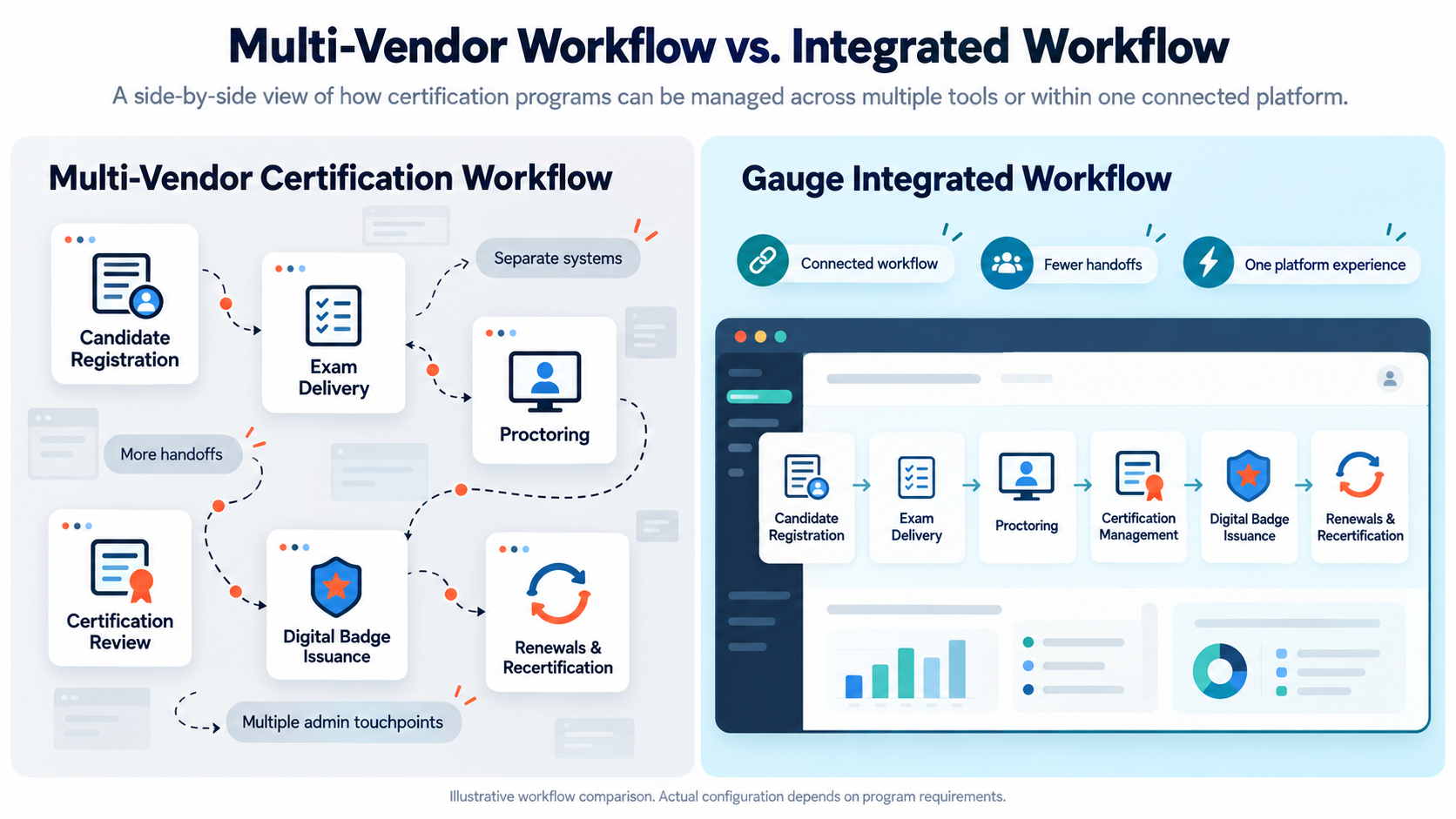
Integrated platforms such as Gauge Online offer a different approach by connecting exam delivery, certification management, digital badging, and renewal workflows within one system, with publicly available starting prices.
The key consideration: If your organization needs more than digital badges, purchasing a separate credentialing platform may increase the number of vendors, integrations, and administrative processes you must maintain. An integrated certification platform could provide greater functionality while reducing your total operating costs.
Understanding Credly’s Pricing Model
Credly does not publish a universal price for its organizational digital credentialing subscriptions. Instead, prospective customers must request a customized proposal based on their program requirements.
According to Credly’s official subscription documentation, organizations operate under one of two usage models, depending on their contract.
Badge-Based Pricing
Under a badge-based subscription, usage is measured by the total number of active badges issued within the subscription period.
If one participant earns three different digital credentials, those credentials count as three badges toward the organization’s subscription usage.
Earner-Based Pricing
With an earner-based subscription, usage is measured by the number of unique individuals receiving valid credentials during the subscription period.
One person receiving several badges counts as one unique earner within that subscription period.
Credly states that revoked and replaced badges do not count toward usage under its published subscription rules. Usage resets for each new subscription period.
For a hypothetical association with 1,000 members earning three credentials each annually, these models would measure usage differently:
| Subscription model | Measured annual usage |
|---|---|
| Badge-based | 3,000 badges |
| Earner-based | 1,000 unique earners |
These figures represent usage, not actual Credly prices. Without the applicable subscription rates, it is not possible to determine which arrangement would be less expensive.
Organizations planning to expand their credentialing programs should clarify which model applies, how additional usage is priced, and what happens when certification volumes increase.
For additional details, see Credly’s official subscription documentation.
What Are You Actually Paying for With Credly?
Credly is an established digital credentialing platform with significant capabilities related to professional recognition and verified achievements.
Its digital credentialing ecosystem helps organizations:
- Issue verifiable digital badges and credentials
- Distribute professional achievements to earners
- Enable credential sharing across professional networks
- Manage digital credential records
- Track badge engagement and sharing activity
- Build structured credential pathways
- Connect credential issuance to other learning and administrative platforms
These capabilities can provide meaningful value, particularly for organizations focused on employee recognition, skills visibility, and professional achievement sharing.
However, digital credentialing is not the same as administering an entire professional certification program.
For organizations that must assess competency, maintain exam records, enforce certification requirements, and manage recertification, issuing the final badge is only one step in a much larger operational process.
The Work That Happens Before a Badge Is Issued
Consider what is required to issue a professional certification based on a qualifying examination.
- Register the candidate and determine eligibility.
- Enroll the candidate in the appropriate certification pathway.
- Develop, maintain, and administer the examination.
- Apply security controls and proctoring requirements.
- Evaluate examination results against passing criteria.
- Issue the appropriate certification and digital badge.
- Maintain records of the achievement.
- Track expiration dates and coordinate recertification.
Digital badging primarily addresses the credential issuance, verification, and recognition portions of this lifecycle.
Credly offers integrations that can connect badge issuance to other systems, but a certification organization may still need separate applications for the underlying assessment and certification processes.
The additional cost is not necessarily the badge itself. It is the technology and administrative infrastructure required to support everything surrounding that badge.
The Hidden Cost of Using Multiple Certification Platforms
Using multiple specialized applications is not inherently inefficient. Some certification programs have established technology environments and prefer dedicated products for each function.
However, the cost of managing several interconnected systems deserves scrutiny, particularly for associations and certification bodies operating with small administrative teams.
1. Multiple Software Subscriptions
An organization using Credly for digital badging may also require separate subscriptions for exam delivery, learning management, certification administration, and other services.
Each subscription should be included when evaluating the total cost of running the credentialing program.
2. Integration Development and Maintenance
When certification records are maintained across multiple platforms, those systems need reliable methods to exchange data.
An exam result may need to trigger a certification approval, update an administrative record, and initiate badge issuance.
These processes can be automated through integrations, but configuration, troubleshooting, and future maintenance may require additional resources.
3. Greater Administrative Complexity
Administrators may need to access several systems to answer routine questions:
- Has this candidate passed the required exam?
- Was the examination administered under the correct security settings?
- Has the certification been issued?
- Is the credential currently valid?
- What must the candidate complete to renew?
- Where can an auditor find the supporting records?
When each answer comes from a different system, even straightforward certification tasks can require additional coordination.
4. Certification Renewal and Recertification
Professional credentials often require more than maintaining a digital record of an achievement.
Organizations may need to notify certificate holders before expiration, accept renewal applications, administer additional exams, verify continuing education requirements, and issue updated credentials.
Without an integrated workflow, administrators may need to coordinate these activities manually or maintain connections between separate products.
Total cost of ownership: A certification platform’s actual cost includes more than its license. Consider software subscriptions, implementation, integration maintenance, proctoring, administrative labor, support, and future program changes.
An Alternative: Manage Your Entire Certification Workflow With Gauge Online
For organizations evaluating Credly pricing because they need digital badges as part of a professional certification program, it may be worth considering a different approach.
Rather than purchasing separate systems for testing, certification administration, and digital credentialing, Gauge Online brings these functions together within a configurable platform.
Gauge has supported online testing and certification programs for more than 25 years, serving organizations with requirements ranging from employee competency assessments to professional certification and compliance testing.
Advanced Exam Delivery
Gauge enables organizations to create and administer assessments with configurable time limits, passing scores, question randomization, question banks, retake rules, and examination records.
These capabilities allow certification administrators to connect competency assessment directly to credential eligibility.
Integrated Proctoring Options
Gauge supports integrations with remote proctoring providers, allowing organizations to incorporate examination security into their existing test administration workflow.
Available proctoring services and associated charges depend on the selected configuration and provider.
Certification and Digital Badging
Gauge’s certification and badging module allows organizations to configure credential requirements and issue certificates and digital badges based on defined program criteria.
Credential records can include expiration dates and verification mechanisms, helping administrators and third parties confirm an individual’s certification status.
Expiration Tracking and Recertification
Certification administrators can establish credential expiration dates, configure renewal communications, and create pathways for recertification activity.
When a program requires an additional examination or other configured activities before renewal, those requirements can be managed within the same environment.
Centralized Reporting and Records
Gauge maintains assessment results and certification-related records within its platform, reducing the need to reconcile exam completion and credential eligibility across unrelated applications.
For organizations subject to external audits, maintaining access to examination history and supporting records is an important operational consideration.
The difference is that digital badging becomes part of the certification workflow rather than a separate destination for the final credential.
Credly vs. Gauge: Comparing the Certification Lifecycle
Credly and Gauge serve different primary purposes. Both offer digital credentialing capabilities, but their approaches to professional certification administration differ.
| Capability | Credly | Gauge Online |
|---|---|---|
| Digital badges | Core capability | Available certification module |
| Credential verification | Yes | Yes |
| Online exam administration | Requires an assessment system | Built-in exam delivery |
| Exam authoring and scoring | Requires an assessment system | Built-in tools |
| Exam proctoring | Handled through external exam systems | Integrated provider options |
| Certification renewal | Credential renewal features; external processes may be required | Configurable renewal and testing workflows |
| Credential sharing network | Established external badge network | Public verification and digital badges |
| Published starting prices | Custom quote required | Available online |
Credly may be the appropriate choice for organizations that primarily value its digital credential network, badge recognition capabilities, and connections to existing learning systems.
Gauge may be more appropriate for organizations looking to combine examination delivery, certification issuance, and renewal management under one vendor.
The right financial comparison should include all required systems and services, not just the digital badging subscription.
Can Gauge Be More Affordable Than Credly?
Potentially, particularly when an organization would otherwise need multiple software products to deliver its certification program.
Because Credly provides custom quotes, it is not possible to make a universal claim that Gauge’s subscription costs less than Credly’s.
However, Gauge provides published starting prices and a configurable pricing model that allows buyers to estimate their costs before committing to a sales process.
Gauge currently publishes the following base plan starting prices:
| Plan | Published starting price |
|---|---|
| Professional | $750/year, plus $250 annual hosting and $500 one-time setup |
| Enterprise | $10,000/year, plus $1,000 annual hosting and $2,000 one-time setup |
Important: These are starting prices for Gauge’s core platform, not all-inclusive digital badging quotes. The certification and badging module is priced separately, and total costs vary with exam volume, modules, and other services.
Gauge’s modular approach allows organizations to select the functionality appropriate for their programs rather than automatically paying for every available feature.
That creates an opportunity to evaluate a broader set of capabilities within a single platform, potentially replacing subscriptions or administrative processes currently managed through separate vendors.
Organizations can review the Gauge Online pricing calculator to develop an estimate based on anticipated usage and required modules.
A Better Way to Calculate Your Total Certification Costs
Before deciding whether Credly, Gauge, or another platform provides better value, build a complete operating cost comparison.
Include the following expenses:
- Exam delivery: Software used to create, administer, score, and report on assessments.
- Proctoring: Monitoring services and integrations required for examination security.
- Digital credentialing: Badge issuance, certificate generation, sharing, and verification.
- Certification administration: Eligibility rules, credential pathways, expiration tracking, and renewals.
- Integrations: Setup, development, testing, and ongoing maintenance between systems.
- Internal administration: Staff time spent updating records, resolving discrepancies, and managing vendors.
- Implementation and support: Initial configuration, migration, training, and ongoing assistance.
For an organization using multiple software products, combining these expenses may reveal a substantially different cost picture than comparing individual licensing fees.
An integrated platform will not eliminate every external cost, especially specialized proctoring services, but it may reduce the number of applications and connections required to administer the program.
The goal is not merely to purchase inexpensive software. It is to deliver a reliable certification program at a sustainable total cost.
Make a More Informed Certification Platform Decision
Comparing certification platforms involves more than reviewing subscription prices. Organizations should also evaluate exam delivery capabilities, digital credentialing, proctoring integrations, renewal management, implementation costs, and ongoing administrative requirements. To help structure that evaluation, Gauge Online developed a Certification Platform RFP Checklist outlining the key considerations when selecting a certification management solution. Whether you’re evaluating Credly alongside existing systems or considering a more comprehensive platform like Gauge, this resource can help you compare vendors based on functionality, total cost of ownership, and long-term operational needs.
Frequently Asked Questions About Credly Pricing
How much does Credly charge organizations?
Credly uses customized pricing for organizational digital credentialing programs. Buyers must request a quote to understand subscription charges, usage allowances, and contractual terms.
Does Credly charge per badge?
Credly supports both badge-based and unique-earner-based subscription models. The applicable model depends on the organization’s contract.
Can Credly manage an entire certification program?
Credly provides digital credentialing and related management capabilities, including integrations with external applications. Organizations requiring exam authoring, secure test delivery, proctoring, and examination records should evaluate additional assessment and certification administration systems.
Is there a more comprehensive alternative to Credly?
Yes. Gauge Online provides an integrated testing and certification management platform with optional digital badging, credential verification, proctoring integrations, and renewal workflow capabilities.
Is Gauge cheaper than Credly?
That depends on the specific Credly quote and the functionality your organization needs. Gauge publishes starting prices and allows buyers to configure their platform. Organizations using separate systems for testing, certification administration, and badges may find opportunities to reduce total operating costs through consolidation.
Before Purchasing Digital Badging Software, Consider the Entire Certification Program
Credly has a well-established position in digital credentialing and offers valuable capabilities for issuing, sharing, and recognizing professional achievements.
But if your organization’s responsibilities extend beyond issuing digital badges, evaluating only Credly’s subscription price may overlook a substantial portion of your actual costs.
Exam administration, security, certification eligibility, reporting, verification, and recertification all require technology and administrative oversight.
For organizations that need these capabilities, Gauge Online offers an opportunity to manage more of the certification lifecycle within a single platform.
Before paying for a separate digital credentialing subscription, determine whether a comprehensive certification management platform could meet more of your needs at a lower total cost.
One Platform. More of Your Certification Workflow.
Why Pay for Multiple Systems Before Exploring One Integrated Solution?
Gauge brings together exam delivery, certification management, digital badging, and renewal workflows. Explore transparent pricing and build an estimate based on what your organization actually needs.
Product and pricing information reviewed October 2026. Vendor features, contract terms, and published prices may change. Request current quotations for a direct cost comparison.